
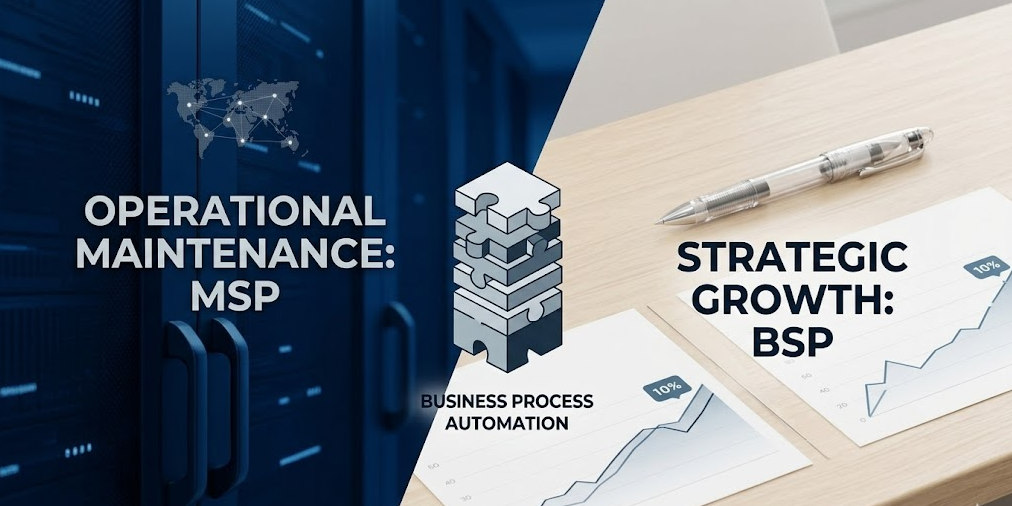
Uptime is a baseline, but strategic growth is the goal.
In the modern business landscape, IT is often viewed as a “utility” a necessary cost to keep the lights on and the servers running. However, a significant shift is occurring. Forward-thinking
organizations are moving away from the traditional Managed Service Provider (MSP) model toward becoming or partnering with a Business Service Provider (BSP).
This isn’t just a name change; it’s a fundamental pivot from operational maintenance to strategic growth.
The Fundamental Shift in Focus
While an MSP focuses on technical availability like uptime and ticket resolution, a BSP focuses on profitability and efficiency. Instead of measuring success through a Service Level Agreement (SLA), the BSP model introduces the Value Level Agreement (VLA).
The conversation changes entirely:
-
The Old Way: “Your server is patched and online.”
-
The New Way: “Your tech stack is reducing churn by 10%.”
How the Evolution Happens
To make this leap, a provider must shift their focus from managing “endpoints” to optimizing workflows. Rather than just ensuring a laptop functions, a BSP analyzes your business processes—such as how a lead becomes a sale. Subsequently, they implement the automation and security needed to make that specific process faster and more profitable.
The transition is complete when IT is no longer seen as a monthly “bill” but as an investment. In the BSP model, the provider stops reporting to the Office Manager. Instead, they collaborate directly with the CEO, CFO, or COO to build the company’s 3-to-5-year roadmap.